

In short
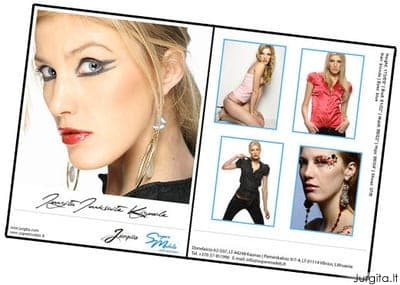
- A composite card, also called a comp card or zed card, is a model's business card: the best pictures, the name, measurements and agency contacts.
- The usual European format is a double-sided A5 card: a portrait and name on the front, three or four different pictures and the measurements on the back.
- A model leaves it with the client after a casting and sends it to agencies. Today you need both a printed and a PDF version.
- You can make one without an agency: at jurgita.cc the card is free to create, and you can order a print-ready PDF or printed cards.
A model's composite card is known worldwide as a comp card, composite or zed card. It is a model's calling card: the best pictures from the portfolio in reduced size, with the model's name, height, measurements and the name of the agency.
Think of it as a business card, only much larger. One side carries a portrait and the name; the other a few of the best pictures from different shoots and the measurements: height, bust, waist, hips, eye and hair colour. Any extra skill or talent can be added.
What goes on a composite card
| Side | Contents |
|---|---|
| Front | One strong portrait, the name (or first name only), the agency logo |
| Back | Three or four different pictures: full length, profile or three-quarter, movement, a different look |
| Measurements | Height, bust or chest, waist, hips, shoe size, hair and eye colour; for men also suit size |
| Contacts | Agency name, phone, e-mail, website; your own if you have no agency |
Measurements are written in centimetres, inches or both, depending on the market: centimetres in Europe, feet and inches in the US and often in the UK. Our size guide converts between them and gives the matching clothing and shoe sizes. Be exact: you will be measured at the casting, and a mismatch costs trust.
Which pictures to choose
A card should show range, not one pretty picture: how you look close up, full length and in different moods.
- The front portrait: natural, with little make-up, so features and skin show.
- Full length: so proportions show.
- Movement or emotion: proof that you can work in front of a camera.
- A different look: a smiling commercial shot next to a fashion one, for example.
Avoid five similar frames from one shoot, heavy retouching, selfies and pictures with other people. Photographers who want to turn their frames into a card for a model may also like our light for photographers page.
Size, design and printing
Designs vary with the agency. The standard European format is A5 (148 × 210 mm), double-sided, on heavier stock; in the US the common size is 5.5 × 8.5 inches, almost the same. Keep the design quiet: a white or pale background, one typeface, pictures without frames or effects. The card is a frame for the photographs, not a poster.
- Resolution. Pictures must be large enough not to look soft in print.
- Bleed. Backgrounds and pictures that run to the edge must extend 3 mm past the trim line.
- Colour. Colours that glow on screen are calmer on paper; skin tones should be neither pink nor grey.
How many cards you need
Order small runs, because a model changes: measurements, hair, the look. As the portfolio is updated, the card should follow. Fewer printed cards are needed than before, since most are sent as PDFs: 20 to 40 is enough for castings and a trip. Pack some when you travel for work; they are on our fashion capitals packing list.
How to make a composite card
A model without an agency can make a card too. It used to mean finding a photographer, choosing the pictures, having someone design the card and taking it to a printer. The system the Supermodels agency built for its own models has since grown into a separate service, Composite Cards (jurgita.cc), open to everyone: signed models, freelance models, photographers and agencies.
- Register and enter your name, measurements and contacts.
- Upload your pictures. The system checks that each has enough resolution for its place on the card.
- Choose a layout and arrange the pictures.
- Creating the card is free. You can then order a print-ready PDF with bleed and crop marks, or printed cards.
Cards for under-18s are made only through a confirmed agency.
When you need it
- At castings: you leave it with the client so they remember you and can reach your agency. See how to prepare for a model casting.
- Applying to agencies: a PDF card attached to an e-mail looks more professional than ten loose pictures. Find agencies in the modeling agency catalogue, and check them first: how to choose a modeling agency.
- During fashion weeks: the card travels with you from casting to casting.
- For photographers: a card for the model after a test shoot is a good way to show your work.
The most common mistakes
- Out-of-date measurements or hair colour. If you have changed, update the card.
- Too many pictures. Four strong ones beat eight average ones.
- Heavy retouching: the client must recognise you when you walk in.
- No contacts, or contacts in tiny print in a corner.
- Printing on thin paper with a home printer.
The card is only part of the preparation
A good card opens the door, but at the casting the walk, posture and the way you introduce yourself decide. We teach these in model training, where you also take your digitals and intro video. If you are not sure which look works best on your card, ask in an image consultation.
Frequently asked questions
What is a composite card?
A model's presentation card with their best pictures, name, measurements and contacts. It is also called a comp card or zed card.
What size is a comp card?
Usually A5 (148 × 210 mm) in Europe and 5.5 × 8.5 inches in the US, double-sided.
Can you make a comp card without an agency?
Yes. Your own contacts go where the agency's would be. For under-18s the card should be made by an agency or the parents.
How many photos go on a comp card?
One on the front and three or four on the back, in different framings and looks.
Who pays for composite cards?
Normally the model, either directly or as a cost the agency advances and deducts from earnings.
How often should you update a comp card?
Whenever your measurements or hair change or you have stronger pictures. Working models refresh theirs at least once a season.
Sources
- Supermodels model agency (supermodels.lt).
- Composite Cards service, jurgita.cc.

Comments (0)
No comments yet. Be the first!
Only logged-in users can comment. Register — and you'll be able to share your thoughts on this article.
Register